The Theory
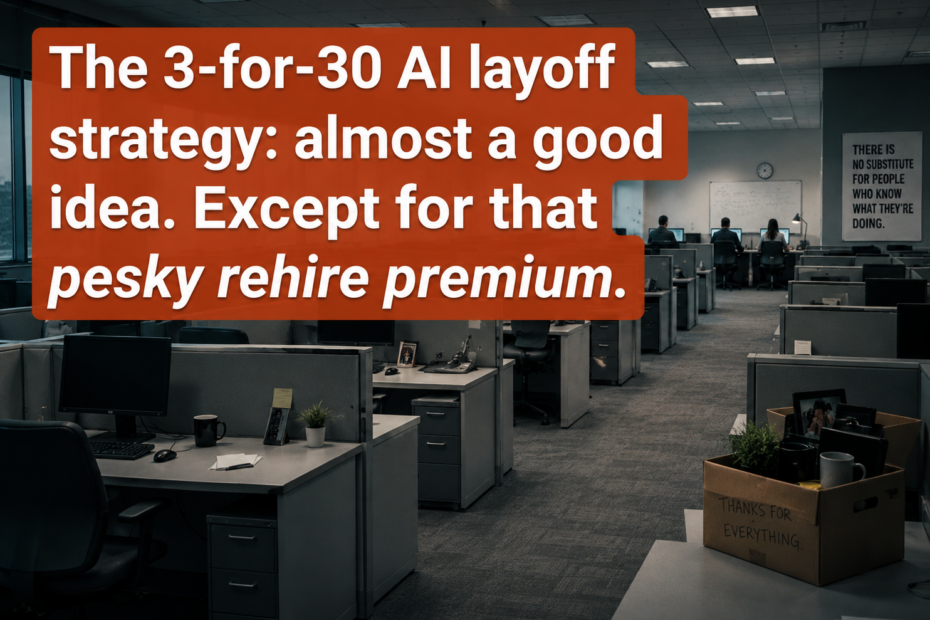
Replace a 30-person department with 3 supervisors and a fleet of AI agents.
Headcount drops. Costs fall. Productivity supposedly rises.
The math is a slam dunk.
The board applauds. The bonuses are wired. The future has officially been optimized.
What could possibly go wrong?
The Reality
Many executives are realizing they outran their headlights
Data from the 2026 AI Boomerang Effect Study (Careerminds), which surveyed 600 HR professionals, suggests that organizations rushing to replace people with AI are running into an uncomfortable problem:
Automation is not a substitute for institutional knowledge.
Sometimes it’s just a faster way to scale mistakes.
The Fallout
52% of leaders reported that AI systems required significantly more human oversight and judgment than expected.
In the 3-for-30 model, those three remaining employees aren’t leading.
They’re supervising a fleet of digital workers who never sleep, never take vacations, and occasionally invent facts with complete confidence.
31% found that rehiring employees—often at higher market rates—cost more than they saved through the original cuts.
Turns out firing experienced people and buying them back later is not always a winning financial strategy.
33% reported losing critical skills and expertise.
That number should surprise no one.
You cannot automate a process you no longer understand.
This is where the theory breaks down.
AI works from the explicit record: procedures, policies, tickets, emails, training materials, and documentation.
Organizations operate on something else as well.
The unwritten rules.
The judgment calls.
The workarounds.
The relationships.
The person who knows why a system fails every third Thursday.
The person who remembers the reason a process exists.
The person everyone calls when nobody else can figure it out.
Most of that knowledge never makes it into a database.
It lives in people.
And people have an annoying habit of leaving with it.
By the time leadership realizes what disappeared, those employees have moved on.
If they return at all, they rarely return at last year’s salary.
Turns out “knowing how the business works” was not legacy overhead.
Efficiency matters.
Delusion is expensive.
If your AI strategy begins by eliminating the people who understand how the work actually gets done, keep their phone numbers handy.
You and HR may be having some interesting conversations.